
 ⏱ 40 min total
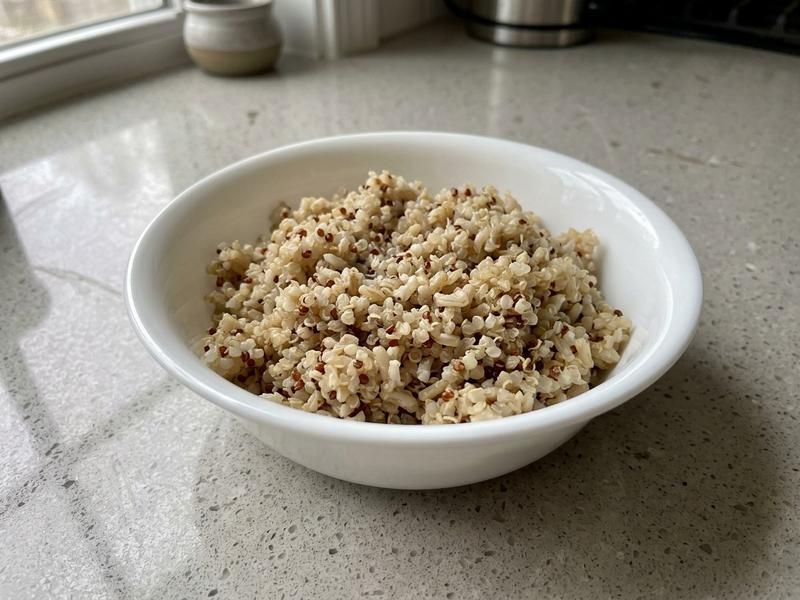
Quinoa and Brown Rice
Per 1 serving · 196 g · 4 ingredients
of a 2,000 cal day
- Protein4.8g10% of calories
- Carbs32g65% of calories
- Fat5.3g25% of calories
- ✓ Low saturated fat
- ✓ Sodium free
- ✓ Sugar free
- ✓ Cholesterol free
At a glance
One serving of Quinoa and Brown Rice (196 g) has 194 calories, with 4.8 g of protein, 32 g of carbohydrates and 5.3 g of fat. Most of its energy comes from carbs (65% of calories). It is high in phosphorus (25% DV), copper (20% DV) and manganese (56% DV).
High in
20%+ of the daily value
- Phosphorus25%
- Copper20%
- Manganese56%
Good source of
10–19% of the daily value
- Thiamine15%
- Vitamin B617%
- Folate (B9)11%
- Pantothenic acid10%
- Iron17%
- Magnesium18%
Watch
20%+ of the daily value
Nothing notable
Ingredients
For one serving. Tap an ingredient to see its nutrition.
- 🥄⅝ cup Water
 ¼ tbsp Olive oil
 ⅛ cup Quinoa
 ⅛ cup Brown rice
Directions
- 1
Rinse the rice/quinoa blend thoroughly under cold water.
- 2
In a medium saucepan, combine water with olive oil and bring to a boil.
- 3
Stir in the quinoa/rice blend, then bring the water back to a boil.
- 4
Reduce the heat to low, cover, and simmer for 25 minutes.
- 5
Remove the saucepan from heat and let it stand, covered, for 5 minutes.
- 6
Fluff the quinoa and rice with a fork before serving.
Vitamins & minerals
Amounts for 1 serving (196 g). Bars show % of the daily value.
Vitamins
| Nutrient | Amount | % Daily Value |
|---|---|---|
| Vitamin A | 0.2 μg | 0% |
| Vitamin C | 0 mg | 0% |
| Vitamin D | 0 μg | 0% |
| Vitamin E | 1 mg | 8% |
| Vitamin K | 2 μg | 2% |
| Thiamine | 0.2 mg | 15% |
| Riboflavin (B2) | 0.1 mg | 6% |
| Niacin | 2 mg | 9% |
| Vitamin B6 | 0.2 mg | 17% |
| Folate (B9) | 44 μg | 11% |
| Vitamin B12 | 0 μg | 0% |
| Pantothenic acid | 1 mg | 10% |
| Choline | 22 mg | 4% |
Minerals
| Nutrient | Amount | % Daily Value |
|---|---|---|
| Calcium | 15 mg | 2% |
| Iron | 1 mg | 17% |
| Potassium | 171 mg | 4% |
| Magnesium | 75 mg | 18% |
| Phosphorus | 174 mg | 25% |
| Zinc | 1 mg | 10% |
| Copper | 0.2 mg | 20% |
| Manganese | 1 mg | 56% |
| Selenium | 7 μg | 13% |
Full breakdown · 43 more nutrients
| Nutrient | Amount | % Daily Value |
|---|---|---|
| Alanine | 0.2 g | — |
| Alpha Linolenic Acid (ALA) | 0 g | — |
| Alpha carotene | 0 μg | — |
| Arginine | 0.4 g | — |
| Aspartic acid | 0.4 g | — |
| Beta carotene | 2 μg | — |
| Caffeine | 0 mg | — |
| Cystine | 0.1 g | — |
| Docosahexaenoic Acid (DHA) | 0 g | — |
| Docosapentaenoic Acid (DPA) | 0 g | — |
| Eicosapentaenoic Acid (EPA) | 0 g | — |
| Fluoride | 0 μg | — |
| Fructose | 0 g | — |
| Galactose | 0 g | — |
| Glucose | 0 g | — |
| Glutamic acid | 1 g | — |
| Glycine | 0.3 g | — |
| Histidine | 0.1 g | — |
| Hydroxyproline | 0 g | — |
| Isoleucine | 0.2 g | — |
| Lactose | 0 g | — |
| Leucine | 0.3 g | — |
| Lycopene | 0 μg | — |
| Lysine | 0.2 g | — |
| Maltose | 0 g | — |
| Methionine | 0.1 g | — |
| Monounsaturated fats | 3 g | — |
| Phenylalanine | 0.2 g | — |
| Polyunsaturated fats | 1 g | — |
| Proline | 0.2 g | — |
| Retinol | 0 μg | — |
| Serine | 0.2 g | — |
| Starch | 11 g | — |
| Sucrose | 0.2 g | — |
| Theobromine | 0 mg | — |
| Threonine | 0.2 g | — |
| Total omega 3 | 0 g | — |
| Total omega 6 | 0 g | — |
| Tryptophan | 0.1 g | — |
| Tyrosine | 0.1 g | — |
| Valine | 0.2 g | — |
| Vitamin D2 | 0 μg | — |
| Vitamin D3 | 0 μg | — |
Burning 194 calories
Estimated for a 70 kg (154 lb) adult using MET values from the Compendium of Physical Activities.
- 37minWalking (3.5 mph)
- 23minCycling (moderate)
- 16minRunning (6 mph)
- 27minSwimming laps
Common questions
How many calories are in Quinoa and Brown Rice?
One serving of Quinoa and Brown Rice (1 serving) has 194 calories, which works out to 99 calories per 100 g. That is about 9.7% of a 2,000-calorie day.
Is Quinoa and Brown Rice high in protein?
Not especially. It has 4.8 g of protein per serving, and protein supplies 10% of its calories. Foods where protein provides 30% or more of calories are generally considered protein-dense.
Is Quinoa and Brown Rice keto-friendly?
It is hard to fit into a strict keto diet. One serving has 29 g of net carbs and 65% of its calories come from carbohydrates, while most keto plans cap net carbs at 20–50 g per day.
How much sodium is in Quinoa and Brown Rice?
2.7 mg per serving, which meets the FDA definition of low sodium (140 mg or less).
How much sugar is in Quinoa and Brown Rice?
0.2 g of total sugars per serving. Labels list total sugars, which include natural sugars from fruit and milk as well as any added sugars.
More recipes
View all 401 calSesame and Peanut Noodles1 serving
 279 calEasy Tuna Casserole1 serving
 91 calBanana Chocolate Chip Muffins1 serving
 273 calQuick White Bean Salad1 serving
 400 calTilapia Piccata with Snow Peas1 serving
 234 calOrange and Pomegranate Salad1 serving
 501 calChicken & Mashed Potatoes1 serving
 170 calAsparagus with Sliced Almonds and Parmesan Cheese1 serving