
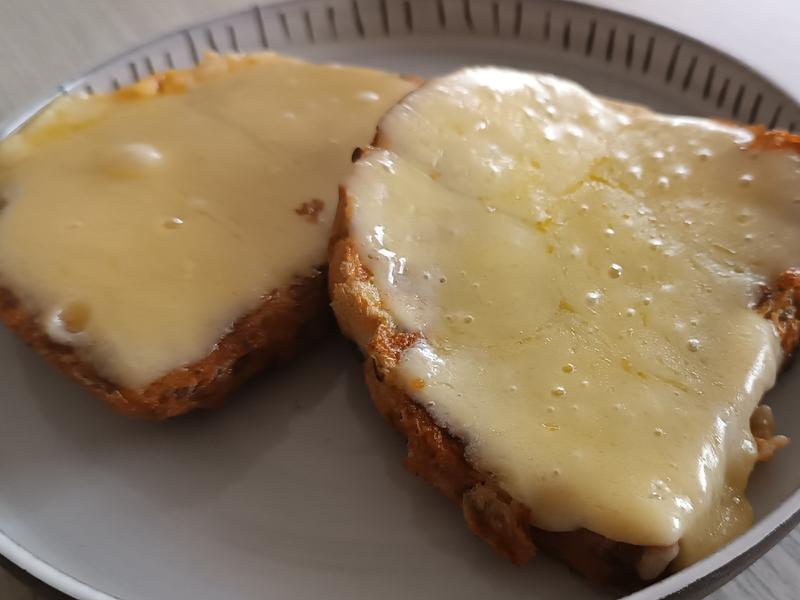
 ⏱ 20 min total
German French Toast
Per 1 serving · 175 g · 5 ingredients
of a 2,000 cal day
- Protein25g24% of calories
- Carbs26g25% of calories
- Fat23g51% of calories
At a glance
One serving of German French Toast (175 g) has 416 calories, with 25 g of protein, 26 g of carbohydrates and 23 g of fat. Most of its energy comes from fat (51% of calories). It is high in protein (50% DV), Vitamin A (27% DV) and thiamine (22% DV). Keep an eye on sodium, saturated fat and cholesterol, which provide 29%, 65% and 59% of the daily value.
High in
20%+ of the daily value
- Protein50%
- Vitamin A27%
- Thiamine22%
- Riboflavin (B2)35%
- Vitamin B1253%
- Pantothenic acid21%
Good source of
10–19% of the daily value
- Dietary fiber12%
- Vitamin E13%
- Niacin16%
- Vitamin B618%
- Folate (B9)12%
- Magnesium15%
Watch
20%+ of the daily value
- Sodium29%
- Saturated fat65%
- Cholesterol59%
Ingredients
For one serving. Tap an ingredient to see its nutrition.


Directions
- 1
Melt the butter in a skillet over medium heat. In a shallow bowl, beat the eggs and milk together.
- 2
Dip each bread slice in the egg mixture, then fry in the skillet until golden brown. After flipping, place a slice of Muenster cheese on top and cover the skillet until the cheese melts.
Vitamins & minerals
Amounts for 1 serving (175 g). Bars show % of the daily value.
Vitamins
| Nutrient | Amount | % Daily Value |
|---|---|---|
| Vitamin A | 242 μg | 27% |
| Vitamin C | 0.1 mg | 0% |
| Vitamin D | 1 μg | 9% |
| Vitamin E | 2 mg | 13% |
| Vitamin K | 6 μg | 5% |
| Thiamine | 0.3 mg | 22% |
| Riboflavin (B2) | 0.5 mg | 35% |
| Niacin | 3 mg | 16% |
| Vitamin B6 | 0.2 mg | 18% |
| Folate (B9) | 47 μg | 12% |
| Vitamin B12 | 1 μg | 53% |
| Pantothenic acid | 1 mg | 21% |
| Choline | 122 mg | 22% |
Minerals
| Nutrient | Amount | % Daily Value |
|---|---|---|
| Calcium | 546 mg | 55% |
| Iron | 2 mg | 27% |
| Potassium | 304 mg | 6% |
| Magnesium | 64 mg | 15% |
| Phosphorus | 472 mg | 67% |
| Zinc | 3 mg | 28% |
| Copper | 0.2 mg | 18% |
| Manganese | 1 mg | 53% |
| Selenium | 33 μg | 60% |
Full breakdown · 43 more nutrients
| Nutrient | Amount | % Daily Value |
|---|---|---|
| Alanine | 1 g | — |
| Alpha Linolenic Acid (ALA) | 0.1 g | — |
| Alpha carotene | 0 μg | — |
| Arginine | 1 g | — |
| Aspartic acid | 2 g | — |
| Beta carotene | 12 μg | — |
| Caffeine | 0 mg | — |
| Cystine | 0.2 g | — |
| Docosahexaenoic Acid (DHA) | 0 g | — |
| Docosapentaenoic Acid (DPA) | 0 g | — |
| Eicosapentaenoic Acid (EPA) | 0 g | — |
| Fluoride | 1 μg | — |
| Fructose | 1 g | — |
| Galactose | 0 g | — |
| Glucose | 1 g | — |
| Glutamic acid | 5 g | — |
| Glycine | 1 g | — |
| Histidine | 1 g | — |
| Hydroxyproline | 0 g | — |
| Isoleucine | 1 g | — |
| Lactose | 2 g | — |
| Leucine | 2 g | — |
| Lycopene | 0 μg | — |
| Lysine | 2 g | — |
| Maltose | 1 g | — |
| Methionine | 1 g | — |
| Monounsaturated fats | 7 g | — |
| Phenylalanine | 1 g | — |
| Polyunsaturated fats | 2 g | — |
| Proline | 2 g | — |
| Retinol | 241 μg | — |
| Serine | 1 g | — |
| Starch | 16 g | — |
| Sucrose | 0 g | — |
| Theobromine | 0 mg | — |
| Threonine | 1 g | — |
| Total omega 3 | 0.1 g | — |
| Total omega 6 | 1 g | — |
| Tryptophan | 0.3 g | — |
| Tyrosine | 1 g | — |
| Valine | 1 g | — |
| Vitamin D2 | 0 μg | — |
| Vitamin D3 | 1 μg | — |
Burning 416 calories
Estimated for a 70 kg (154 lb) adult using MET values from the Compendium of Physical Activities.
- 79minWalking (3.5 mph)
- 50minCycling (moderate)
- 35minRunning (6 mph)
- 59minSwimming laps
Common questions
How many calories are in German French Toast?
One serving of German French Toast (1 serving) has 416 calories, which works out to 237 calories per 100 g. That is about 21% of a 2,000-calorie day.
Is German French Toast high in protein?
It provides a solid 25 g of protein per serving (50% of the 50 g daily value), but protein supplies only 24% of its calories, so it is not a protein-dense food. Foods where protein provides 30% or more of calories are generally considered protein-dense.
Is German French Toast keto-friendly?
It is hard to fit into a strict keto diet. One serving has 23 g of net carbs and 25% of its calories come from carbohydrates, while most keto plans cap net carbs at 20–50 g per day.
How much sodium is in German French Toast?
666 mg per serving, which is high (20% or more of the 2,300 mg daily value).
How much sugar is in German French Toast?
4.7 g of total sugars per serving. Labels list total sugars, which include natural sugars from fruit and milk as well as any added sugars.
More recipes
View all 251 calShiitake and Scallion Ramen1 serving
 547 calCreamy Mushroom Ramen1 serving
 328 calSriracha Ramen Noodles1 serving
 342 calCitrus Spinach Salad1 serving
 373 calTurkey, Spinach & Tomato Pita Pizza1 serving
 298 calBalsamic Salmon1 serving
 235 calCucumber Avocado Toast1 serving
 378 calChicken Stew1 serving