

Whole wheat flour (whole-grain) nutrition facts
Per 1 cup · 120 g
of a 2,000 cal day
- Protein16g15% of calories
- Carbs86g79% of calories
- Fat3g6% of calories
- ✓ Low fat
- ✓ Low saturated fat
- ✓ Sodium free
- ✓ Cholesterol free
At a glance
One serving of Whole wheat flour (whole-grain) (1 cup, 120 g) has 408 calories, with 16 g of protein, 86 g of carbohydrates and 3 g of fat. Most of its energy comes from carbs (79% of calories). It is high in protein (32% DV), dietary fiber (46% DV) and thiamine (50% DV).
High in
20%+ of the daily value
- Protein32%
- Dietary fiber46%
- Thiamine50%
- Niacin37%
- Vitamin B638%
- Iron54%
Good source of
10–19% of the daily value
- Riboflavin (B2)15%
- Folate (B9)13%
- Pantothenic acid14%
Watch
20%+ of the daily value
Nothing notable
Vitamins & minerals
Amounts for 1 cup (120 g). Bars show % of the daily value.
Vitamins
| Nutrient | Amount | % Daily Value |
|---|---|---|
| Vitamin A | 0 μg | 0% |
| Vitamin C | 0 mg | 0% |
| Vitamin D | 0 μg | 0% |
| Vitamin E | 1 mg | 6% |
| Vitamin K | 2 μg | 2% |
| Thiamine | 1 mg | 50% |
| Riboflavin (B2) | 0.2 mg | 15% |
| Niacin | 6 mg | 37% |
| Vitamin B6 | 0.5 mg | 38% |
| Folate (B9) | 53 μg | 13% |
| Vitamin B12 | 0 μg | 0% |
| Pantothenic acid | 1 mg | 14% |
| Choline | 37 mg | 7% |
Minerals
| Nutrient | Amount | % Daily Value |
|---|---|---|
| Calcium | 41 mg | 4% |
| Iron | 4 mg | 54% |
| Potassium | 436 mg | 9% |
| Magnesium | 164 mg | 39% |
| Phosphorus | 428 mg | 61% |
| Zinc | 3 mg | 28% |
| Copper | 0.5 mg | 55% |
| Manganese | 5 mg | 212% |
| Selenium | 74 μg | 135% |
Full breakdown · 35 more nutrients
| Nutrient | Amount | % Daily Value |
|---|---|---|
| Alanine | 1 g | — |
| Alpha carotene | 0 μg | — |
| Arginine | 1 g | — |
| Aspartic acid | 1 g | — |
| Beta carotene | 6 μg | — |
| Caffeine | 0 mg | — |
| Cystine | 0.3 g | — |
| Docosahexaenoic Acid (DHA) | 0 g | — |
| Docosapentaenoic Acid (DPA) | 0 g | — |
| Eicosapentaenoic Acid (EPA) | 0 g | — |
| Fructose | 0.1 g | — |
| Glucose | 0 g | — |
| Glutamic acid | 5 g | — |
| Glycine | 1 g | — |
| Histidine | 0.4 g | — |
| Isoleucine | 1 g | — |
| Leucine | 1 g | — |
| Lycopene | 0 μg | — |
| Lysine | 0.4 g | — |
| Methionine | 0.3 g | — |
| Monounsaturated fats | 0.3 g | — |
| Phenylalanine | 1 g | — |
| Polyunsaturated fats | 1 g | — |
| Proline | 2 g | — |
| Retinol | 0 μg | — |
| Serine | 1 g | — |
| Starch | 69 g | — |
| Sucrose | 0.4 g | — |
| Theobromine | 0 mg | — |
| Threonine | 0.4 g | — |
| Total omega 3 | 0 g | — |
| Total omega 6 | 0 g | — |
| Tryptophan | 0.2 g | — |
| Tyrosine | 0.3 g | — |
| Valine | 1 g | — |
How it compares
Calories per 100 g, so different serving sizes compare fairly.
- Bob's Red Mill Flour, Whole Wheat, 100% Stone Ground368
- Bob's Red Mill Whole Wheat Flour, Organic, 100% Stone Ground368
- King Arthur Baking Company White Whole Wheat Flour, Stone-Ground367
- Gold Medal Flour, All Natural, Whole Wheat367
- Kodiak Power Flour, Protein-Packed367
- King Arthur Baking Company Whole Wheat Flour357
- Whole wheat flour (whole-grain)340
Similar foods
 100 calKing Arthur Baking Company Whole Wheat Flour¼ cup−308 cal
 110 calKing Arthur Baking Company White Whole Wheat Flour, Stone-Ground¼ cup−298 cal
 140 calBob's Red Mill Flour, Whole Wheat, 100% Stone Ground¼ cup−268 cal
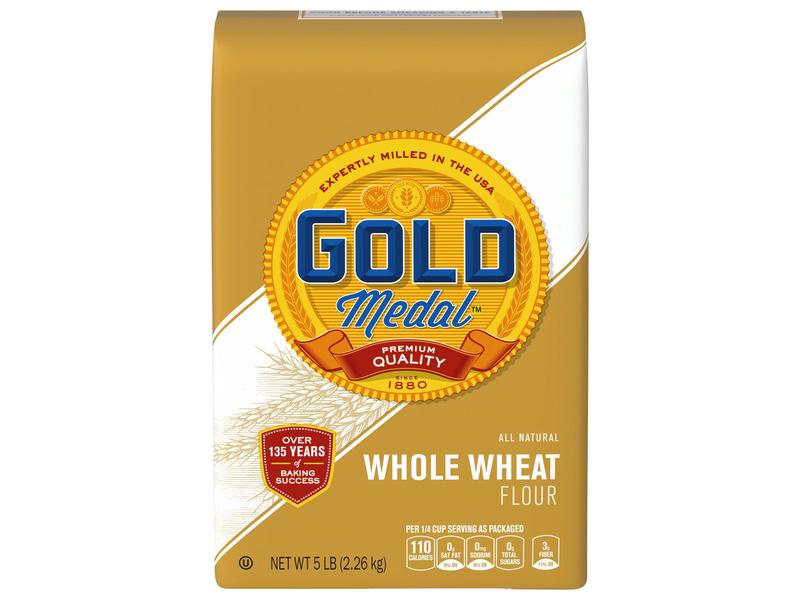 110 calGold Medal Flour, All Natural, Whole Wheat¼ cup−298 cal
 140 calBob's Red Mill Whole Wheat Flour, Organic, 100% Stone Ground¼ cup−268 cal
 110 calKodiak Power Flour, Protein-Packed¼ cup−298 cal
Burning 408 calories
Estimated for a 70 kg (154 lb) adult using MET values from the Compendium of Physical Activities.
- 77minWalking (3.5 mph)
- 49minCycling (moderate)
- 34minRunning (6 mph)
- 57minSwimming laps
Common questions
How many calories are in Whole wheat flour (whole-grain)?
One serving of Whole wheat flour (whole-grain) (1 cup) has 408 calories, which works out to 340 calories per 100 g. That is about 20% of a 2,000-calorie day.
Is Whole wheat flour (whole-grain) high in protein?
It provides a solid 16 g of protein per serving (32% of the 50 g daily value), but protein supplies only 15% of its calories, so it is not a protein-dense food. Foods where protein provides 30% or more of calories are generally considered protein-dense.
Is Whole wheat flour (whole-grain) keto-friendly?
It is hard to fit into a strict keto diet. One serving has 74 g of net carbs and 79% of its calories come from carbohydrates, while most keto plans cap net carbs at 20–50 g per day.
How much sodium is in Whole wheat flour (whole-grain)?
2.4 mg per serving, which meets the FDA definition of low sodium (140 mg or less).
How much sugar is in Whole wheat flour (whole-grain)?
0.5 g of total sugars per serving. Labels list total sugars, which include natural sugars from fruit and milk as well as any added sugars.
Recipes with whole wheat flour


More bread, grains & pasta
View all 261 calSourdough bread (French/Vienna style)1 slice, large
 170 calWhole wheat pita bread1 pita, large
 675 calWhite rice (long-grain, regular, raw, enriched)1 cup
 45 calSpaghetti (cooked, enriched, salt added)1 oz
 626 calQuinoa (raw)1 cup
 685 calBrown rice (long-grain, raw)1 cup
 96 calWhole wheat dinner rolls1 medium whole wheat dinner rolls
 133 calLucky Charms cereal (ready-to-eat, General Mills)1 cup